Amongst the translucent accessories, sparkles and ballet flats recirculating as 2023 trends, is another more shocking prediction – shoplifting! Ugh, that’s definitely a Fashion Law violation.
Homeland Security has warned retailers that organized retail crimes (ORC) are rampantly increasing, leaving many companies preparing for the worst this year. ORC typically involves groups of individuals who steal property with the intent to sell and distribute. The idea is for these criminal enterprises to convert stolen merchandise into cash, or even return them to the original store for credit.
Perhaps, this is what 2018 Reddit users were trying to warn us about after Sandra Bullock’s Return Scam scene in Ocean’s 8, because since then ORC has risen to a $100 Billion problem. The 2022 end of year National Retail Security Survey found that retail crime rose by 26.5%. Because theft is higher than it has historically ever been, retail companies warn that 2023 may bring bigger security changes.
Major retailers such as Target, Walmart and Walgreens have been incredibly public about their concerns with shoplifting, often with conflicting views on how to subdue it. Just this week, Walgreens CFO, James Kehoe, told investors on the Walgreens Boots Alliance, Inc. First Quarter 2023 Earnings Conference Call that perhaps they overplayed shoplifting concerns in 2022.
However, Doug McMillon, Walmart’s CEO, has said that if the theft problem continues in their stores, it could lead to closures and price jumps. (To that I say – Criminals, please stop stealing, I’m just a broke law student trying to afford my shopping addiction, any price increase might kill me XD)
In all seriousness, shoplifting is headed to crisis proportions. Retailers are still recovering from the pandemic–with labor shortages and supply chain back ups, they can’t afford to keep locations open if ORC continues. In the last few years, shoplifting has turned into an entirely different beast, with even violence at the forefront.
Currently, 38 states do not consider shoplifting a felony unless merchandise worth $1,000 or more is stolen. On Social Media, many California residents have even taunted that shoplifting is therefore legal. However, the truth is that because state laws hold that stealing merchandise worth less than $951 is a misdemeanor, law enforcement doesn’t bother to investigate. So while shoplifting is rarely prosecuted, it is still illegal and a huge issue.
Many store policies prohibit employees from confronting shoplifters. A viral TikTok by a Target employee circulated a while back, saying that Target watches shoplifters on camera but won’t stop them unless they steal a certain amount of inventory. Target has since said that ORC led to over $400 million in lost profits in 2022. Many stores now take precautions to lock up more items than before. And I’ll admit, it’s pretty annoying to have to track down an employee to unlock the product. Just this month, I chased down a CVS employee to help me with the press-on nails. A humbling moment for me and my bare manicure for sure.
But, what are retailers left to do? Some say, it’s time for lawmakers to get involved so maybe this is the year we see shoplifting become more than a misdemeanor. Who’s to say it won’t work! I mean, the risk of facing a felony for a Walmart Tank-top has got to deter some people…right!?
If you have an Instagram account, you are probably familiar with the repurposed jewelry trend. In my first assignment for my Intellectual Property: Licensing & Drafting class, I chose to focus on a case that profiles this industry. You can read my assignment below:
On February 2, 2021, Chanel filed suit against Shiver and Duke, LLC (“S+D”) for misappropriating its famous interlocking “C” monogram trademark and “Chanel” word mark. Chanel alleged that S+D had taken monogrammed “CC” buttons, meant only for Chanel-authorized clothing, and resold them as repurposed designer accessories. Chanel brings forth claims that S+D’s commercial interest is reliant on Chanel’s “iconic trademark on the jewelry” and use of the CHANEL name to “promote and market” accessories. Chanel alleges that S+D knowingly and willfully took Chanel’s marks, rather than creating their own unique product line. The complaint is brought under Section 32(1) of the Lanham Act, 15 U.S.C. for trademark infringement, unfair competition and trademark dilution. Applying the Lanham Act to the use of repurposed designer buttons and pieces for commercial use could set precedent for reclaimed designer accessories sold in an unauthorized manner. In the last couple years, many major design companies, including Chanel, have settled trademark infringement cases regarding upcycled goods. This case, in particular, is so important because it could be the first case brought to trial in the United States, without an outside settlement agreement. Businesses that repurpose vintage designer materials for profit may have to find new and distinct product lines that do not include federally registered trademarks. Although the case has not yet been decided, Chanel has provided a strong argument for their case and will likely pursued the court to decide in their favor.
Shiver and Duke is an accessory company that sells costume bracelets, chains and earrings, using Chanel buttons as the main charm and attraction; they prominently display and sell under the mark “CHANEL”. The buttons used by S+D were not provided with Chanel’s consent, and may not have been obtained from genuine Chanel products. Chanel provided representative examples of both Chanel’s genuine costume jewelry and S+D’s button jewelry. S+D markets and sells to the same consumer audience as Chanel, through a variety of channels across the United States, including a retail website. S+D has advertised and sold the repurposed accessories as authentic Chanel costume pieces. Chanel provided a printout of S+D’s webpage that displays images of bracelets with the interlocking “C” monogram being promoted as “Designer Chanel Stone Bracelet”. Chanel sent S+D a cease and desist letter, demanding that they halt sales, which S+D did not respond to, they instead made changes to their website to remove Chanel-titled marks.
In May of 2021, S+D produced a memorandum in support of their motion to dismiss for lack of personal jurisdiction or in the alternative, to transfer under forum non-conveniens. The district court denied the motion, because S+D had not shown by clear and convincing evidence that the case should be dismissed or transferred, and therefore the case will move forward in the Southern District of New York. Following the opinion and order denying the motion to dismiss, the court
directed counsel for all parties to appear at an Initial Pretrial Conference on October 18, 2022, in New York, New York. Subsequently, Shiver and Duke filed a motion for extension of time to answer the complaint, which they were granted on September 13, 2022.
American and European courts have given trademark owners the upper hand in brand protection cases. While this may be the first case to set precedent in the U.S., The Court of Justice of the European Union has found that repurposing and reselling designer goods has the ability to undermine the fame of designer brands. In a decision (CJEU C-337/95), the European Court held that trademark owners may oppose the use of their trademark by a reseller when “the use of the trademark for this purpose seriously damages the reputation of the trademark”. Europe’s precedent is similar to the US’s First Sale Doctrine, whose role is now being challenged when it comes to modified and upcycled designer goods. This case raises a fascinating issue that will affect major designer brands and smaller retailers in the upcycle space.
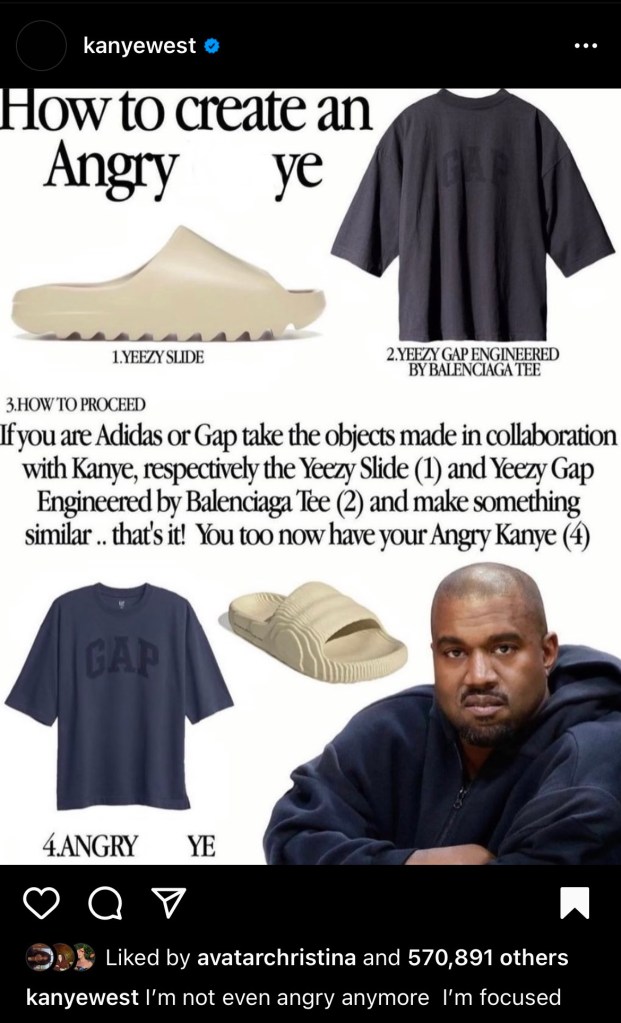
As they typically do, more of Kanye West’s Instagram posts have people talking. Over the last two days, West, or simply “Ye” has posted on Instagram 17 times. Lucky for Pete Davidson, these 17 posts are all in public outrage of his creative partner’s Gap and Adidas.
Earlier today, Ye took to Instagram saying “I’m not even angry anymore I’m focused”. The famous rap singer and clothing designer is coming for Adidas and Gap, for allegedly making products that are too similar to the Yeezy slide and Yeezy Gap/Balenciaga Tee.
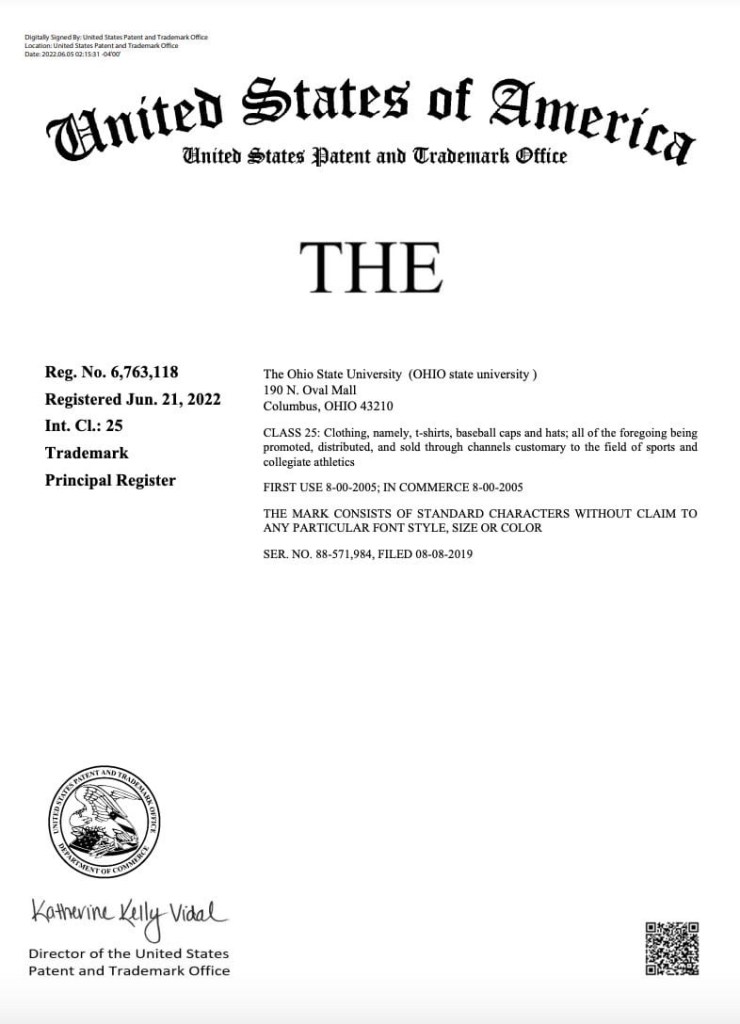
In the world of Intellectual Property, accusing someone of trademark infringement is not for the faint of heart. Ye is no stranger to this process; he owns 79 trademarks and has been on both sides of an infringement battle. But now, is he just straight fed up?
Today, Ye seems to be going by just “Angry Ye”. His latest Instagram posts come just a day after he was seen delivering an angry rant in front of Gap Executives. He appears to give executives an ultimatum in which he seeks to take Gap to the “next level” with his own creative direction.
Ye’s above post was on Instagram for less than 6 hours.
Ye even compares himself to Tom Brady and Gap to his football team. Yet, this “Gap Quarterback” was no team player. He accused the Gap team members of having meetings about “his designs” behind his back and ended the rant in expletives.
In the midst of Ye’s public rage against Gap, his company is filing even more trademarks. This latest filing is for “YZYSPLY” in clothing, a Class 025 mark and Retail stores, retail store services, and on-line ordering services and on-line retail store services available on a global computer network, all of the aforesaid featuring clothing and accessories therefore, footwear and headwaear, a Class 035 mark.
As Ye publicly berades Gap and Adidas, he is taking matters into his own hands to grow Yeezy into an even bigger international clothing company, with retail stores across the globe. He blames his partners for not making permanent enough stores and he plans to open his first outlet on his own, in Atlanta.
In one of five videos Ye has posted in the last day, he urges fans to back him in his ventures saying, “Who would be best to open it? I’ll buy the land and or building then we gonna open up in every state and then internationally. Anyone who has over 10 years retail experience and is ready to change the world post your Instagram handle or store location in the comments and we’ll find you.”
Ye has blurred the line between creative insanity and creative genius, and it’s only a matter of time we find out where on the spectrum his 80th trademark will fall.
*Ye has since deleted any Instagram posts criticizing Gap and Adidas
A blog piece written during my summer experience at Gearhart Law, including a video from “IP in the News” on the Passage to Profit Show – Road to Entrepreneurship, a radio show and podcast syndicated on 30+ radio stations across the US sponsored by Gearhart Law, LLC.
Take away the cigarettes and the natural blonde hair, and I’m turning into Carrie Bradshaw – meaning, I went shopping to cure my writer’s block. I had been sitting in front of the same screen, struggling to find the purpose behind my words.
And I really did find them in the Forever 21 dressing room, trying on a cherry-printed sundress. A cherry-printed sundress, that I almost bought by the way. Almost, because, I was quickly humbled by my boyfriend who said, “I like it but it looks like fast fashion”. I’ve taught him so well!
The hard truth is that Fashion is the third most polluting industry, just behind energy and transportation. And not only is the Fast Fashion industry polluting, wasting water (and still somehow letting people wear crocs), it’s contributing a whole 10% of humanity’s carbon emissions.
But, shopping is hard. How do we align our ethics with our favorite brands and where do we compromise?
For the last couple of years, I have committed to reducing my carbon footprint when it comes to fashion. And that’s not to say, that I don’t slip sometimes (especially when I’m in desperate need of a dress, it’s 8pm and Forever 21 is all I have left) but I have come up with shopping boundaries.
For starters, I will not shop at Shein, Romwe, Boohoo, Pretty Little Thing, or Missguided. Small “nevers” that may one day add up and make a difference because frankly, I shop a lot.
It is undoubtedly the moral culpability of these brands to stop forced labor and overproduction. We as consumers validate this unethical behavior every time we press “add to cart”. When we make a conscious decision to limit our clothing waste, we become a part of the solution instead.
Let’s start small with these 6 easy ways YOU can commit to reducing your closet’s carbon footprint!
Share Hey look, a new way to guilt your sister into lending you that top!
If anybody knows that “sharing is caring” it’s a college girl on a Friday night. Because when bras are flying and Tanologist bottles are being cranked out, there are no boundaries between roomies. And I can’t even tell you how many times my whole entire weekend was saved by my roommate’s wardrobe.
Our closets were so intertwined that by the end of college we had to ship clothes back to each other.
Dressing up in clothes that make you feel comfortable is so important because our outfits are a part of our identities. Developing a personal style is fun and exciting so don’t start compromising your uniqueness to dress like a friend but if you can borrow a piece then all the better!
When you’re living with all your girlfriends, there’s no point in having three American Eagle denim skirts in the house. It’s not like you’d wear them at the same time anyway.
Rewear Yes, even if you posted in it on Instagram…
Recent studies have focused on the fact that most young women consider an article of clothing to be old after just three wears. It is estimated that the average person wears something 7-10 times before they get rid of it.
This is one of the reasons why Shein is one of the worst companies for the environment. Not only do over 95% of their clothes contain new plastics, they profit on fads. They use cheap production to rapidly release the latest trending item and produce it in throwaways. Because, especially in the age of social media, “Outfit repeaters” get a bad rep. When really, buying high-quality staples will never go out of style.
Bury me in my black (vegan) leather jacket, she has seen it all! There’s not much of a difference between any of these outfits: a neutral turtle neck layered under a jacket with skinny jeans. What makes an outfit pop is accessories, keep your staples and switch out pops for different occasions.
Know your wash rules Pee-yew!
Experts have set up recommendations for how often you should wash the following:
Workout Gear – 1 wear
Underwear, socks, undershirts – 1 wear
Shirts – 1 to 2 wears
Pajamas – 2 to 3 wears
Most pants – 2 to 3 wears
Bras – 4 wears
Jeans – 4 to 5 wears
Sweaters – up to 6 wears, dependent on undershirts
Of course, and this should go without saying, if clothes have smells or stains they should be washed as soon as possible. There’s mostly no need to wash your clothes every day but use your judgment. I ain’t condoning any BO-ridden shirts to be worn twice!
Shop Sustainablywatch out for greenwashing fools!
One of the coolest things about social media and the digital age is access to information at our fingertips. I don’t really expect everyone to do this but something that helps me decide where to shop is a quick google search on the ethics behind where I shop. This is one of the most difficult things to filter as a consumer because many think well, how are we supposed to know where our clothes come from? Which is silly because we should. We know where most of our resources come from, including food, so why not clothes. Many brands have begun to vow to a standard of ethics and sustainability so if your favorite brand is still not transparent about this 🚩
Clothing brands aren’t perfect and if we swear off every one of them we’ll be left, well…naked. So, vowing to be more conscious of how often you shop at a certain place or what an equally priced alternative might look like could be the start to a more sustainable wardrobe.
Thrift & Gift wear those hand-me-downs!
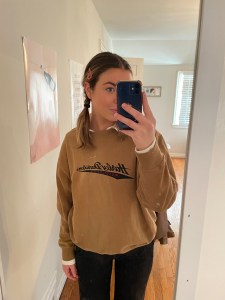
@averageguythrifts found me this vintage Harley Davidson crewneck so I didn’t have to!
I am not going to try and act like I am a thrift store connoisseur because I have never boughten anything directly from a thrift store. But, what I do is follow Instagram accounts that repurpose or resell clothing. My favorites are either @averageguythrifts or @covetboston on Instagram, especially for luxury vintage finds. Keeping clothes in the fashion circuit for longer, avoids greenhouse gas emissions, pollution, and exploitation.
However, when gifting or donating items, it is our responsibility to understand where these may end up.
The following to links will be the most effective in teaching you how the fast fashion industry and its leftover ‘donations’ are deteriorating the planet.
Besides the obvious waste of packaging that returning a too mini mini-skirt, returns themselves can actually wind up in landfills. In fact, an estimated 5 billion pounds of returned goods end up in landfills each year. Few times do returned clothes actually end up on the rack, even if it’s clearance. Major companies, like Amazon, who frankly don’t care about the environment, will trash or carbonize returns because processing and reselling items costs more than destroying them.
It is important to understand that when you are ordering an article of clothing online, they are often made by the masses. Then, when a store does not sell as many units as expected or prints mistakes, these pieces are sent to landfills. That is why brands that utilize “pre-order” features or make pieces as their ordered are favorable. Companies like Nuuly, Stich Fix, and Rent the Runway keep pieces in the market without overordering.
Both Little Caesars and the NFL have happily announced their multi-year partnership. And with less than a month to go before preseason, they’re making sure everyone is Hot-N-Ready for kickoff!
The NFL is no stranger to significant sponsorships, just last season they had 41 league-level corporate sponsors on their roster. So, why is the orange caricature of the late Roman dictator Julius Caesar dancing across our browsers more than other mascots?
Despite being ranked behind both Pizza Hut and Dominos for the title of the largest pizza chain in the world, Little Caesars is replacing the NFL’s former sponsor, Pizza Hut.
Papa Johns first held the title of official pizza sponsor and stood for eight years before their former CEO John Schnatter blamed the company’s declining sales on NFL player protests and ended their agreement.
Then Pizza Hut, 2,000+ units larger than Little Caesars, sponsored the NFL for four seasons.
And while Papa John’s still holds the official pizza sponsorship for the NBA and MLB, it’s a fair fight in the big four right now because Little Caesars is also the official pizza delivery of the NHL. But, extraordinary for corporate sponsorships in the sports world, this particular deal is going viral.
President and CEO of Little Caesars, Dave Scrivano has said, “This partnership aims to enhance the fun of game day by bringing the quality and convenience Little Caesars is known for to NFL fans across the country, and because we’re the value leader in the pizza industry, hungry fans can enjoy weekly Gametime meals at a very affordable price during a time when food prices are on the rise.”
Some might even say, Little Caesars is the underdog of pizza. Is it safe to compare this sponsorship come-up to Cincinnati making it to the Super Bowl?
A stretch, maybe, but you’ll think of me when the Baader-Meinhof bias kicks in and you see Little Caesar’s everywhere. Because trust me they’re on the rise.
Hey, I’m not looking for an endorsement myself here but I will take the title of Winning Time: The Rise of the Laker’s Dynasty fangirl. I pause here to tell you to get to at least the sixth episode and come back.
Depicted in Episode Six is a scene between Magic Johnson and Nike co-founder Phil Knight that is said to have taken place in 1979. In this scene, Knight offers Magic competitive stock in NIKE with a custom line of shoes. A ledger showed that Magic could have made 5.2 billion dollars by now.
The figures in this scenario are in dispute. But, what we do know is that the 18-cent stock price Magic was shown to be offered did not actually debut until 1980, when Magic was already two years into a deal with Converse. Nike was not even public in 1979, but neither Phil Knight nor Nike have commented on the inaccuracies of the show.
Figures aside, cash offers were way more favorable to a 19-year-old boy, who did not understand stock. Still, Magic jokes in the press that he regrets passing up on this Nike deal and maybe he should have put his faith in them over Converse.
“Boy, did I make a mistake,” Johnson said in a 2017 interview with Ellen DeGenerous, “I’m still kicking myself. Every time I’m in a Nike store, I get mad. I could’ve been making money off of everybody buying Nikes right now.”
But, Converse was founded in 1908 and Nike was founded in 1964 so, 1979 Johnson thought he was following the money. Yikes!
Come 2001, Converse filed for Chapter 11 bankruptcy due to unmanageable debt. Chapter 11 is perhaps the most complicated form of bankruptcy but simply, it allows a company to just restructure and stay in business. To keep themselves on their feet, Converse had to turn to a third party And I think that third party can be accredited for Converse mid-2000s rise in popularity.
Nike, the one and only, acquired Converse in 2003 as a wholly-owned subsidiary. Since then, Nike has owned 100% of Converse stock. Today, NIKE, Inc. has 54 wholly-owned subsidiaries, meaning they own 100% of the stock of 54 other companies; making them the parent company of Converse and well 53 others.
So while The Rise of the Laker’s Dynasty may have kicked off the Magic news, it’s the rise of Nike that deserves airtime.
Nike didn’t give up on basketball stars; in 1984 they agreed to pay $250,000 upfront to Micheal Jordan and create him a personal sneaker line. That infamous Air Jordan line just reached its 37th anniversary; now the long history of Nike Air Jordans can be simplified to three syllables: Pow-er-house.
The real Phil Knight knew what he wanted and went after it: a major shoe company that redefined the American sneaker market and a basketball ‘GOAT’ to help him get there.
So, if you finally got to episode six and find yourself feeling bad for the poor Nike salesman and shouting “just do it” to Magic, know that everyone turned out okay (and rich) in the end.
Now the point of this article is not to dissect my shopping habits, but my definition of window shopping is totally different from Merriam Webster’s; once I see a display I like, there’s no stopping me from going inside the store.
And that’s exactly why I am Free People’s target audience. Free People expects to grab their consumers through images, colors, and individualism. Free People’s origin story is even shared on their website, where they explain what kind of consumer they expect to appeal to.
“And that’s just who we wanted to reach: a 26-year-old girl, smart, creative, confident and comfortable in all aspects of her being, free and adventurous, sweet to tough to tomboy to romantic. A girl who likes to keep busy and push life to its limits, with traveling and hanging out and everything in between. Who loves Donovan as much as she loves The Dears, and can’t resist petting any dog that passes her by on the street.”
Free People’s Story began with a husband and wife in 1970s Philadelphia but is now a colossal clothing theme beyond just their brand, everywhere women look for that FP-esq boho vintage wear. Still, their marketing concepts can be as simple as a boutique window display. Fashion Law looks at the way brands connect products with trusting consumers and the relationships that are built through brand marketing.
If the Free People girl is free and adventurous then what’s stopping us from putting on a pair of pants and being her!?
Months ago I walked past a Free People storefront and saw a mannequin sporting the cutest pair of plaid pants. I love a good pair of pants, but more than that, I trust a good pair of Free People pants. Long story short, I was rushed by my mom and sister, couldn’t find any plaid numbers on the rack, and left pantsless (well I was wearing leggings but…you know what I mean).
If you think that stopped me, you’re wrong because one of Free People’s greatest marketing schemes saved me. Each of their items is uniquely named, so when inquiring about a pair of plaid pants, one must know if they are looking for the “Love Buzz”, “Scotch & Soda” or “Jules” pair. And can I just say, this is pure genius! Not only is the brand ensuring that retailers and consumers can identify articles of clothing, but they are also making the shopping experience entirely personal.
Because if these particular pants were just called “Yellow Plaid” I would not have looked so hard, but they weren’t. They were called Plaid Jules Pants in the Blackbird Combo Color and that “Jules” part kept me interested. It was like I was back in Kindergarten trying to find my name on the giftshop keychain. And perhaps, every other Julia felt this way since they’ve been sold out for 5 months (If anyone finds them I’m a size 4).
I digress…
For decades, some of our favorite fashion products have been personified through names whether we realized it or not.
Arguably the most iconic and luxurious bag known to man, the Hermès Birkin Bag was named after British actress Jane Birkin after she sat next to Hermès Chief Executive on a 1983 flight. But for the everyday girl, smaller boutiques and clothing stores we mostly all can afford, name their items too. I’m wearing Brandy Melville’s Jules top as we speak (I can’t help that everything stylish is named after me).
Like the 26-year-old Free People girl, brands pick clothing themes and names that coincide with one another and allow you to take on their persona. Not only does naming your items allow for recognition, but it also allows for girls to play dress-up again. Fashion is an experience and the way we shop should reflect that.
Almost every mentor and practicing Fashion Attorney I have had the opportunity to connect with has reiterated the fact that Fashion Law is marketing. We all market ourselves and the way we dress while doing it, markets for these clothing brands. So as I sit here head to toe in anything named Jules, I say, the Free Peoples of the world are doing it right.
Non-fungible tokens (NFTs) are at the vanguard of the fashion industry so anyone with a walk-in closet better listen up. Digital clothing might soon have more worth than anything material hanging in there. And as NFTs become more and more mainstream, fashion brands will have no choice but to enter the game (and I mean that literally-have you played Louis Vuitton Endless Runner?)
The metaverse we all once cringed over is becoming the new normal; the most favorable brands have begun to enter the NFT market to create their own digital wardrobes.
Virtual Realities exist in the metaverse, digital spaces that mimic real life. Just like real life, people are going to want different digital outfits to wear each day.
There are events and environments for different users to interact, the entire metaverse is focused on digital social interaction. Soon, you’ll need to buy a new virtual wardrobe to match your virtual lifestyle.
The fashion industry has already begun planning for the digital wear demand, with virtual fashion shows. So saying things like, “Can my avatar get an invite to the 3D metaverse fashion week?” won’t actually sound so ridiculous. In fact, a virtual fashion week is coming to the metaverse in March.
The metaverse is showing up to be one of the biggest media forms for brands to advertise their collections. Digitally produced clothing can minimize the number of physical prototypes used in collection promotion. Brands such as Ray-bans, Tommy Hilfiger, and Calvin Klein give you the option of “virtual try-on”, promoting the fact that clothes will automatically tailor to your avatar’s body.
But, perhaps the most intriguing brand to emerge from NFT fashion is DressX, a website that allows users to send in pictures or videos of themselves to have the digital clothes they buy fitted onto their person. And no, not like Yves Saint Laurent’s virtual lipstick try-on. Purchases from DressX never ship home to you; you stay dressed in an entirely digital world.
DressX stands behind their mission, sending a message on sustainability because “Production of a digital garment emits 97% less of CO2 than production of a physical garment.”
Listen, I am all for sustainability but the creative protection that comes with NFT clothing is really what sold me.
An NFT is a unique token that is created to exist on a recording system called a Blockchain. Blockchains make replication impossible. This allows NFT customers to be confident that they are not being cheated. It also allows for designers to be confident that their goods are in fact unique.
Harvard Business Review has estimated that the real-world market for physical luxury knock-offs is a $4.5 trillion business. In the NFT world, luxury brands and other creators have better protection against infringement.
Knock-off products not only harm business but also the reputation of proud luxury brands. Gucci belts became way less attractive once nobody could tell the difference between the ones coming from Italy versus the faux coming from Amazon.
Now, Gucci has officially joined Prada, Cartier, and Louis Vuitton in the digital world; already spearheading the market with a Superplastic collaboration. With the impossible heist of counterfeiting Suppergucci, I don’t see that $4.5 figure staying in the trillions for long.
Basically, If you’re interested in pitching up a meta-walk in closet, I’d get started soon because the luxury NFT drops are not going to stop.
Faced with a blind taste test, many would favor the infamous General Mill’s Cheerios over the Trader Joe’s O’s, as cereal competitors. Faced with choosing between the two iconic breakfast yellow boxes may prove to be the harder task.
In 2017, The US trademark court office first denied Cheerio’s request to trademark the color yellow in the breakfast world. Cheerios failed to provide adequate enough reasons for the yellow to be their intellectual property.
In 2018, General Mills was shut down again by the US Trademark Trial and Appeal Board. The judge, in this case, denied the cereal brand from having exclusive rights to the color yellow. He claimed that it is industry practice for breakfast brands of all kinds to market themselves with bright colors.
Trademarking a color allows a particular brand to use a specific and unique color combination while preventing other companies, in the same industry, from also using it.
The Lanham Act of 1946 provides the definition of a trademark as a “mark used in commerce or registered with a bona fide intent to use it in commerce” See 15 U.S.C. § 1127.
The first color was trademarked in 1958 by Owens-Corning for the color pink in insulation products. Close your eyes – can you picture it?
If you know insulation pink, you are probably familiar with other trademarked colors – Tiffany Blue, Loubiton Red, John Deere Green, Hermes Orange, T-Mobile Magenta – the list goes on.
Certainly, it would be much harder to identify one mobile communication company from another if we allowed them all to use Magenta.
As for cereal? We love Kix, Captain Crunch, Honey Combs, and Pops all too much to allow Cheerios the intellectual property rights of yellow.
So pip pip cheerio to the trademark of breakfast yellow for now!






 Legally Beau Monde